True Blue Lending
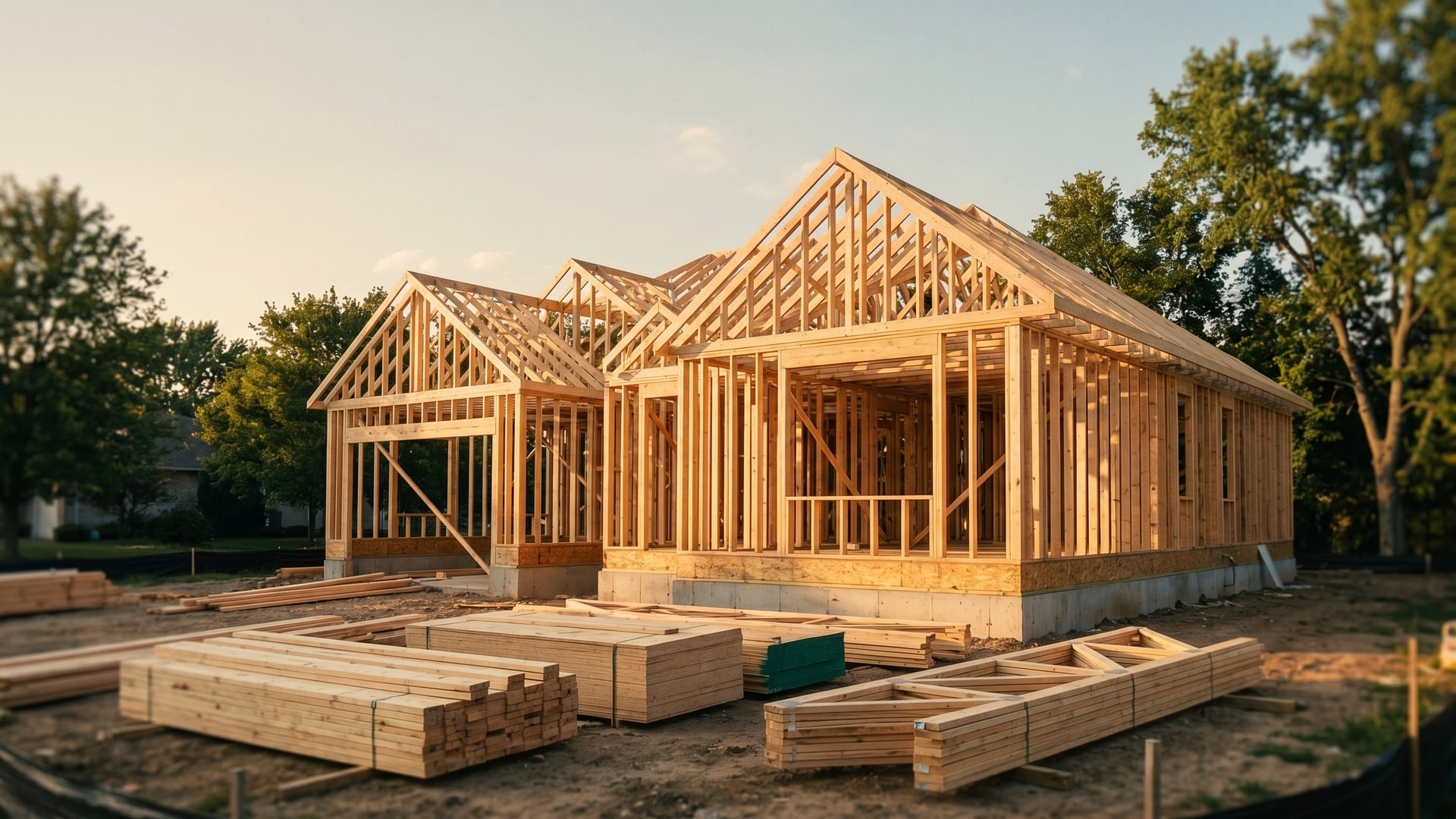
A new single-family home at the framing stage of construction — fresh lumber framing rising over a poured foundation on a quiet suburban lot, with stacks of lumber in the foreground lit by warm golden-hour light

FHA Construction

Build new. One closing.

The FHA One-Time Close construction-to-permanent loan finances the lot, the build, and the permanent 30-year mortgage in a single closing at 96.5% LTV — the lowest-down-payment path to a brand-new home.

The short version

An FHA construction loan — formally the FHA One-Time Close (OTC) construction-to-permanent loan — finances the land, the construction costs, and the permanent mortgage in one loan with one closing, insured by the Federal Housing Administration. The minimum down payment is 3.5% (96.5% LTV), construction must finish within 11 months, and the loan automatically modifies to a 30-year fixed mortgage when the certificate of occupancy is issued. No second closing, no requalification, no second set of closing costs.

How the FHA One-Time Close works

One closing covers the lot, the build, and the 30-year mortgage

A traditional construction project needs two loans: a short-term construction loan, then a "take-out" mortgage that refinances it when the home is done. Two closings, two sets of closing costs, and a requalification in between — if rates move or your income changes mid-build, the take-out can fall apart with a half-finished house on the line.

The FHA One-Time Close collapses that into a single FHA-insured loan that closes before ground breaks. During construction you make interest-only payments on the drawn balance. When the home is complete and the certificate of occupancy is issued, the loan automatically modifies to a standard 30-year fixed FHA mortgage — no new application, no new appraisal, no second closing.

Because the permanent financing is locked before construction starts, the borrower carries no take-out risk. The price of admission is standard FHA mortgage insurance: a 1.75% upfront premium (UFMIP) financed into the loan, plus the annual MIP of 0.15%–0.75% that applies to every FHA loan.

StructureSingle-close construction-to-permanent (C2P)
Max LTV/CLTV96.5% — 3.5% minimum down payment
Construction phaseUp to 11 months, interest-only on drawn balance
ConversionAutomatic modification to 30-year fixed at certificate of occupancy
UFMIP1.75% of base loan amount, financed
Annual MIP0.15%–0.75% per year (LTV + term dependent)

Right fit for

  • Owner-occupant buyers building a new primary residence instead of competing for resale inventory
  • Borrowers who qualify for FHA on a finished home but want to build
  • Buyers in markets where new construction is cheaper than comparable resales
Watch
FHA VA Conventional One-Time Close Construction-to-Perm Basics

Borrower eligibility & 2026 loan limits

Standard FHA credit and DTI flexibility, applied to a build

Qualifying for an FHA construction loan looks like qualifying for any FHA loan: most lenders want a 620 FICO on the OTC product (some accept 580 with overlays), and FHA's AUS commonly approves debt-to-income ratios up to 56.99% with strong compensating factors. The property must be your primary residence — FHA does not finance investment-property construction.

The total loan amount — land plus construction plus financed UFMIP — must fit within your county's FHA loan limit. For 2026, the FHA floor is $541,287 in standard-cost counties and the ceiling is $1,249,125 in high-cost counties (per HUD's CHUMS limits, effective January 1, 2026). Look up your county before designing the build — the limit caps the project budget.

The down payment is 3.5% of the total acquisition cost (lot plus construction). Gift funds are permitted, the same as on any FHA loan, and if you already own the lot, its equity can cover some or all of the down payment — see the land section below.

Min credit620 typical for OTC (some lenders 580 with overlays)
Max DTIUp to 56.99% with AUS approval and compensating factors
OccupancyPrimary residence only — owner-occupant
Loan limit (2026)County-specific: floor $541,287, ceiling $1,249,125
Down payment3.5% of total acquisition cost; gift funds permitted

Right fit for

  • Buyers with 580–680 FICO who would price unfavorably on a conventional construction loan
  • High-DTI files where conventional construction underwriting declines but FHA AUS approves
  • Families using gift funds for the down payment on a build

Buying the lot — or using land you already own

Land equity can be your down payment

The One-Time Close finances the lot purchase and the construction in the same closing — you don't need to buy the land first with cash or a separate lot loan. The purchase price of the lot simply becomes part of the total acquisition cost the loan is sized against.

If you already own the lot, its value works in your favor: equity in the land counts toward the 3.5% minimum investment. On a lot with enough equity, borrowers frequently close the construction loan with little or no additional cash out of pocket. If the lot was purchased more than 12 months before the application, most lenders use its current appraised value rather than the original purchase price.

One restriction to know: FHA OTC requires construction to start after the loan closes. The appraisal cannot show anything beyond foundation completion at the start, and re-using an existing old foundation is not permitted on FHA — that scenario routes to a conventional construction product instead.

Lot purchaseFinanced in the same single closing
Already-owned landEquity counts toward the 3.5% minimum investment
Land owned 12+ monthsCurrent appraised value used (lender-dependent)
Existing foundationNot permitted on FHA OTC — conventional only

Right fit for

  • Buyers who inherited or were gifted a buildable lot
  • Rural and exurban buyers pairing a low-cost lot with a new build
  • Borrowers who bought land years ago and want to build with minimal new cash

Builder approval, draws, and the construction phase

Licensed builder required — no owner-builder on FHA

The builder and the project must be approved by the lender before clear-to-close: a licensed, insured general contractor with a track record, a fixed-price construction contract, plans, specs, and a budget. FHA does not allow owner-builder construction — you cannot act as your own general contractor on an FHA OTC, even if you hold a GC license. (That path exists only on certain conventional construction programs.)

During the build, the lender disburses construction funds in draws tied to completed work, verified by inspection. A contingency reserve of 5% of the construction cost is held by the lender to absorb overruns and change orders. You pay interest only on the balance actually drawn — early in the build the payments are small and they grow as the home progresses.

Construction must finish within 11 months. Pre-started projects — where the builder or borrower broke ground before the loan was submitted — are not permitted on FHA OTC; construction must begin after loan submission.

BuilderLicensed + insured GC, lender-approved before closing
Owner-builderNot permitted on FHA (conventional-only scenario)
DrawsInspection-verified disbursements against completed work
Contingency reserve5% of construction cost held by lender
Construction window11 months maximum
Pre-started constructionNot permitted — must start after loan submission

Right fit for

  • Buyers building with a production or custom builder on the builder’s lot or their own
  • Projects with a fixed-price contract and a clean plans-and-specs package

Manufactured and modular homes

New manufactured homes on permanent foundations qualify

FHA OTC isn't limited to stick-built construction. A new manufactured home placed on a permanent foundation is eligible as a 1-unit, non-jumbo transaction — the loan finances the land, the home, the foundation, and the site work in the same single closing. The home must be new (first installation), titled as real property, and meet HUD's manufactured-housing construction standards.

Modular homes — factory-built sections assembled on site that meet the same state and local building codes as site-built homes — are treated as site-built construction for FHA purposes, with no special restrictions.

ManufacturedEligible — new, 1-unit, non-jumbo, permanent foundation
TitlingMust be titled as real property, not personal property
ModularTreated as site-built — standard OTC rules apply

Right fit for

  • Buyers pairing an affordable lot with a new manufactured home
  • Rural buyers where manufactured housing is the dominant new-construction option

When another program fits better

203(k) for renovating, VA OTC for vets, conventional for flexibility

Building new isn't always the answer. If the better deal in your market is an existing home that needs work, the FHA 203(k) renovation loan finances the purchase and the rehab in one loan — same FHA credit flexibility, applied to remodeling instead of ground-up construction.

If you're an eligible veteran or service member, the VA One-Time Close does the same single-close construction structure at up to 100% LTV — zero down. And if you have 5%+ down and stronger credit, a conventional OTC at up to 95% LTV avoids FHA's upfront and annual mortgage insurance entirely, and it's the only route that permits pre-started construction or existing-foundation scenarios.

Renovating insteadFHA 203(k) — purchase + rehab in one loan
VA-eligibleVA One-Time Close at up to 100% LTV
Stronger credit/downConventional OTC at up to 95% LTV, no MIP
Pre-started / existing foundationConventional only

Right fit for

  • Buyers comparing build-new vs renovate-existing in the same market
  • Veterans who want zero-down construction financing
  • Borrowers optimizing total cost across FHA vs conventional construction routes

Frequently asked

What people ask before they apply.

Plain-English answers to the questions we hear most often on FHA construction scenarios. Have one we missed? Call (305) 703-9001.

What is an FHA construction loan?

An FHA construction loan — formally the FHA One-Time Close (OTC) construction-to-permanent loan — is a single FHA-insured mortgage that finances the land, the construction costs, and the permanent 30-year mortgage with one closing held before construction starts. The minimum down payment is 3.5% (96.5% LTV), and the loan automatically converts to a standard 30-year fixed FHA mortgage when the home is complete and the certificate of occupancy is issued.

What is the down payment on an FHA construction loan?

3.5% of the total acquisition cost — lot plus construction — for borrowers with a 580+ FICO, the same as any FHA loan (most OTC lenders want 620+). The down payment can come from gift funds, and if you already own the lot, equity in the land counts toward the 3.5% minimum investment, which often reduces the cash needed at closing to little or nothing.

Is an FHA construction loan the same as a One-Time Close loan?

Yes — "FHA construction loan," "FHA One-Time Close," "FHA OTC," and "FHA construction-to-permanent (C2P) loan" all refer to the same product: one FHA-insured loan, one closing, covering both the construction phase and the permanent mortgage. The alternative — a separate construction loan followed by a take-out refinance — is called a "two-time close" and is not an FHA product.

Can I use land I already own as my down payment?

Yes. Equity in a lot you already own counts toward the 3.5% minimum required investment on an FHA One-Time Close. If you've owned the lot more than 12 months, most lenders use its current appraised value rather than your original purchase price. Borrowers with sufficient land equity frequently close with no additional cash down.

Can I be my own builder on an FHA construction loan?

No. FHA requires a licensed, insured general contractor approved by the lender — owner-builder construction is not permitted on the FHA One-Time Close, even if you hold a GC license yourself. Owner-builder scenarios route to certain conventional construction programs instead.

How long can construction take on an FHA One-Time Close?

Up to 11 months. During the construction phase you make interest-only payments on the amount drawn so far. Construction must begin after the loan is submitted — pre-started projects are not eligible on FHA — and a 5% contingency reserve is held by the lender to cover overruns.

What happens when construction is finished?

The loan automatically modifies to a standard 30-year fixed FHA mortgage when the certificate of occupancy is issued. There is no second closing, no requalification, no new appraisal, and no second set of closing costs — the permanent rate and terms were locked at the original closing before construction started.

Do FHA loan limits apply to construction loans?

Yes. The total loan amount — land plus construction plus the financed 1.75% UFMIP — must fit within your county's FHA loan limit. For 2026 the floor is $541,287 in standard-cost counties and the ceiling is $1,249,125 in high-cost counties. Check your county's limit before finalizing the build budget.
Authoritative sources

Where the rules come from.

Independent references for everything claimed on this page. We cite primary sources so you can verify before you decide.

HUD — Single-Family Housing Policy Handbook 4000.1

The FHA bible — new-construction, builder, and maximum-mortgage rules live here.

HUD — FHA Mortgage Limits

Official county-by-county FHA loan limit lookup (CHUMS).

HUD — Manufactured Housing Program

HUD construction and safety standards for manufactured homes.

NMLS Consumer Access

Verify True Blue Lending's license (NMLS #2380218).

Ready when you are

Pricing a build? Send the numbers.

Twenty-minute call. Bring the lot price (or what you own), the builder’s contract price, and your credit ballpark — we’ll size the FHA One-Time Close against your county’s loan limit and quote the permanent payment before you commit to the builder.

Prefer to talk first? Call (305) 703-9001